
The Expiration Date of Alpha: Why Momentum Dies After 12 Months
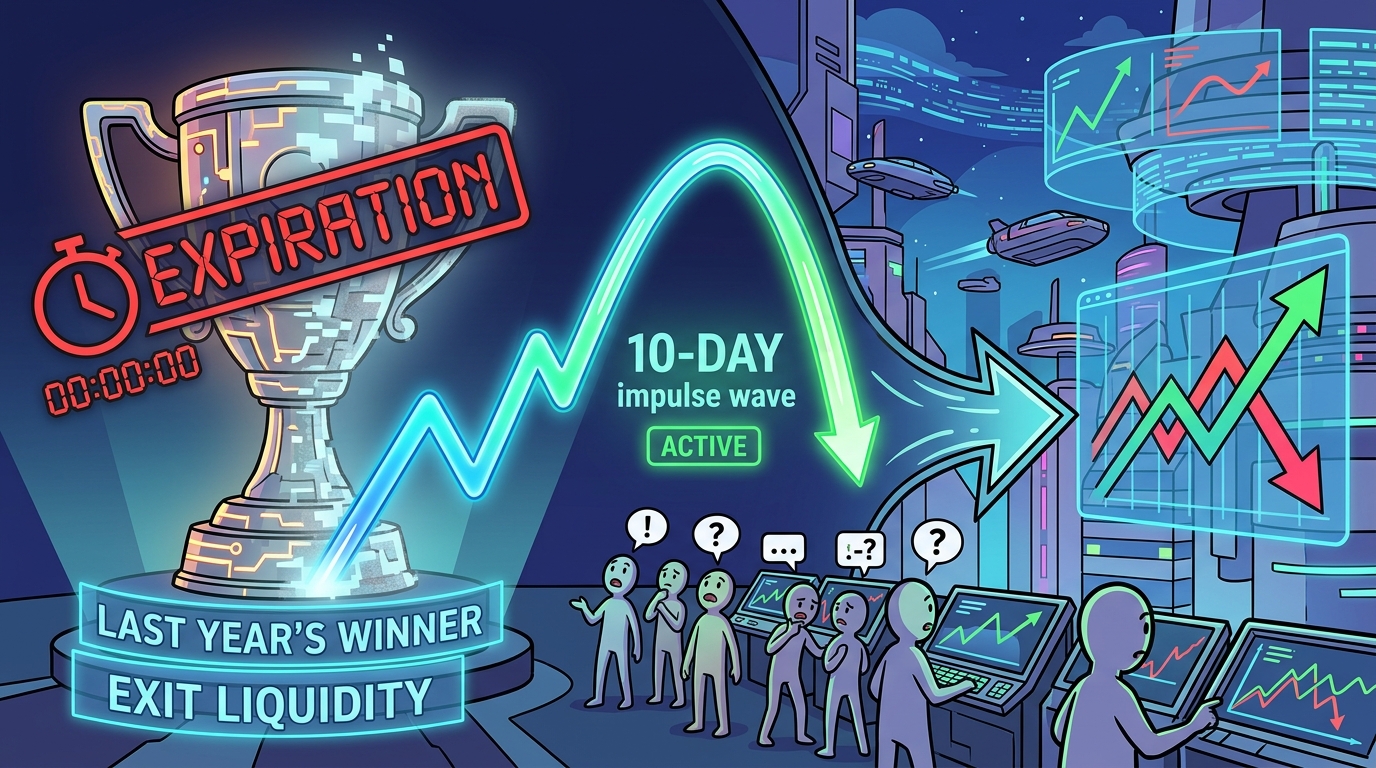
Long-horizon winners become tomorrow's exit liquidity. We trade 10-day relative impulses — not 12-month trophies.
Long-horizon winners become tomorrow's exit liquidity. We trade 10-day relative impulses — not 12-month trophies.
The Trap of the "Strong Chart"
Open any retail trading forum and you will find the same screenshot: a sector ETF that has doubled over the past year, a 200-day moving average sloping gently upward, and a caption that says "the trend is your friend."
That chart is not a signal. It is a tombstone with a delayed inscription date.
In academic finance, the classic cross-sectional momentum anomaly — rank assets by trailing 3-to-12-month returns, buy the winners, short the losers — is one of the most replicated results in the literature. It works. Until it doesn't. The same literature is equally clear about the sequel: beyond roughly twelve months, intermediate-term momentum tends to reverse. Last year's champions start underperforming. The alpha has an expiration date stamped on the packaging, whether or not the chart looks "healthy."
The Macro-Rotational Portfolio was built around that uncomfortable fact. We do not ask "who won the last year?" We ask "who is violently sucking capital away from everyone else right now — and is that impulse still alive?"
Why 12-Month Momentum Rotts
A twelve-month winner is not a free lunch. It is a crowded trade wearing a valuation premium.
Three forces quietly kill the edge:
- Crowding and capacity. Once a theme has printed a spectacular trailing return, every systematic book, every CTA overlay, and every "momentum factor" ETF is already long. The next buyer is no longer an informed allocator — they are the exit liquidity for someone who got there first.
- Mean reversion of relative valuation. A sector that has outperformed for a full year has usually stretched its relative multiple. Capital that chased the narrative eventually rotates toward the next underpriced story. Relative strength becomes relative exhaustion.
- Macro regime half-life. The economic logic that powered the move — AI capex, inflation scare, rate-cut euphoria — rarely survives a full calendar year intact. By month twelve, the narrative is priced, contested, or already dead. Holding the 12-month winner is holding yesterday's cause with today's price.
This is why a strategy that ranks sleeves by trailing 252-day returns will look brilliant in a smooth bull tape and then quietly bleed when leadership rotates. The signal is not wrong about the past. It is late about the present.
What We Actually Trade: Impulse, Not Trophy
Our live system never computes a 12-month momentum score for capital allocation. The raw signal is always the same two-step transform:
# Macro-Rotational Portfolio: short-horizon relative impulse
log_spread = np.log(price_A / price_B)
percentile_rank = log_spread.rolling(10).apply(
    lambda x: pd.Series(x).rank(pct=True).iloc[-1] * 100
)
Ln(A/B)measures who is beating whom — the cumulative return gap between two economically linked assets, free of the asymmetry bias of simple division.- The 10-day rolling percentile asks a brutally local question: is today's relative strength extreme versus the last two trading weeks?
When Ln(SMH/XLK) hits the 95th percentile, we are not celebrating that semiconductors had a good year. We are detecting that, over the past ten sessions, capital is flooding into semis versus broad tech at a rate that beats almost every day in that window. That is an impulse — a short-lived, high-signal burst of relative demand.
Institutional sector rotation, in our observation, concentrates its position-building inside roughly one to two weeks when a macro narrative flips. A 50-day or 252-day window is too slow: by the time it screams "buy," the accumulation phase is over. A 3-day window is too noisy. Ten days is the golden window Walk-Forward Optimization keeps selecting — long enough to confirm a theme, short enough to enter before the move is exhausted.
The System's Built-In Expiration Clock
If alpha has an expiration date, the code must enforce it. We do not rely on hope, conviction, or a pretty equity curve.
1. Hysteresis exit — kill the trade when the impulse dies
Entry requires the 10-day percentile above ~90. Exit fires when it falls below ~80. The band in between absorbs noise; the hard exit refuses to babysit a fading relative-strength story. We do not wait twelve months to discover the winner has become a loser. We leave when the short-horizon impulse collapses.
2. Cross-sectional ranking — no loyalty to last quarter's king
Eligible sleeves are ranked against each other every day. Capital concentrates on the strongest current ranks (Top-3 dynamic sizing). A sleeve that dominated last month but now sits at the bottom of the cross-section gets zero allocation — even if its absolute chart still looks like a masterpiece. Darwinism, not nostalgia.
3. Macro blockers — refuse entries when the regime invalidates the logic
Yield-curve stress, VIX term-structure inversion, and targeted hedges can veto an otherwise "strong" momentum print. Relative strength inside a liquidity vacuum is not alpha; it is a trap with better marketing.
4. Portfolio metabolism — strategies expire too
Individual trade impulses die in days to weeks. Entire economic logics die in quarters to years. That is why Hermes runs quarterly sleeve audits — live-vs-backtest slippage, Sharpe drift, correlation shifts — and why decayed legs get culled for WFO-validated replacements from the alpha backlog. The market changes the exam questions after you learn the answers. A portfolio that cannot swap spark plugs will eventually seize.
The Practical Lesson
Retail momentum usually means: "this went up a lot for a long time; buy it."
Professional relative-value momentum, as we implement it, means: "capital is rotating violently along a validated economic chain right now; ride the impulse; exit when the impulse dies; never marry the narrative."
That is the difference between collecting trophies and collecting alpha.
Twelve-month trailing strength is a useful historical description. It is a terrible live signal. By the time an asset has spent a year at the top of the leaderboard, the easy money has already been made by someone else's system — and your job, if you buy it then, is to provide them a polite exit.
Trade the logic. Measure relative impulses on a short clock. Enforce expiration with hysteresis, cross-sectional ranking, and ruthless sleeve rotation. Alpha does not die because the math stopped working. Alpha dies because the crowd arrived, the valuation stretched, and the macro story aged out.
The expiration date was always printed on the label. Most traders just refuse to read it.